
We Must Stop Judging Our Neighbors
Updated: Jun 4

I HAVE A DEEP AVERSION TO TELLING others what to do, feel, or say. In this essay, I throw this personal commitment overboard.
Why?
Because I just read a Pew Research report from March that says “Americans are more likely than people in other countries surveyed in 2025 to question the morality of their fellow countrymen.”
According to Pew, “The United States is the only place we surveyed where more adults (ages 18 and older) describe the morality and ethics of others living in the country as bad (53%) than as good (47%).”
To this, I say: Please stop judging your neighbors.
People in Kenya, Nigeria, Poland, and Sweden do not condemn their neighbors. Americans do. People in Spain, Indonesia, and Canada do not condemn their neighbors. Americans do.
And you know what’s worse for me since I am one? “Democrats and independents who lean toward the Democratic Party are much more likely than Republicans and Republican leaners to rate fellow Americans as morally and ethically bad…” by a huge margin: 60% vs. 46%!
My fellow liberals can be very judgemental of others whose lawn signs differ from their own. And we often have a grotesquely distorted understanding of who we are judging, i.e., what others actually believe. This was revealed in the Perception Gap research.
These researchers asked Americans to guess what they believe are the views of others who vote differently than they do and then calculated the difference between these predictions and reality.
For example, if you are a Democrat, what percentage of Republicans do you think agree with the statement, “Racism still exists in America?” Would it surprise you if this were a high number?
You can find out and assess your own accuracy here. It takes less than five minutes. I’m not being self-righteous. The first time I took the test, I found out I had a high perception gap.
The Perception Gap researchers found that the most partisan, politically active Americans—Progressive Activists and Devoted Conservatives—were most likely to misperceive the other, saying that “Democrats and Republicans imagine almost twice as many of their political opponents as reality hold views they consider ‘extreme’.” You can see those groups on the extreme right and left of the graphic, below:

And who is most accurate in guessing the views of others? Americans who watch almost no TV news, who read few or no news stories, and who are the least politically engaged. They are those in the middle of the graphic, above. “We found that the more news people consumed, the larger their Perception Gap.”
Well, you might say, I have a graduate degree. Surely, I have a good read on how others really feel.
Sorry.
On the Perception Gap quiz, the more educated one is, the poorer one is at empathizing with others, especially if you lean left. “Democrats’ understanding of Republicans actually gets worse with every additional degree they earn.” Ouch. That one lands close to home.
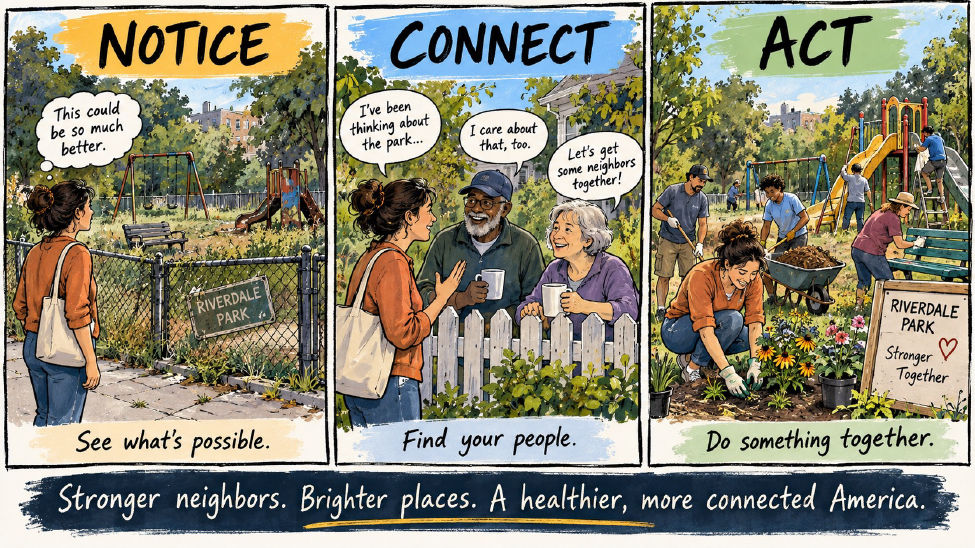
Honestly, I am not castigating my fellow Democrats or fellow advanced degree holders. I am appealing to all Americans—first and foremost to myself—to give one another a break.
When any of us—Democrats, Republicans, Independents, educated or uneducated—see another as a suspect or an enemy, we start believing that just about anything is justified to beat the other. The people in the middle of the political spectrum—the 67% of us the Hidden Tribes study calls the Exhausted Majority—tune out and disengage. A system of self-government cannot succeed this way.
This is why I say please stop judging your neighbors.

Comments