
The Three Magic Words of Citizenship
I GAVE A PRESENTATION THE OTHER DAY ABOUT CITIZENSHIP.
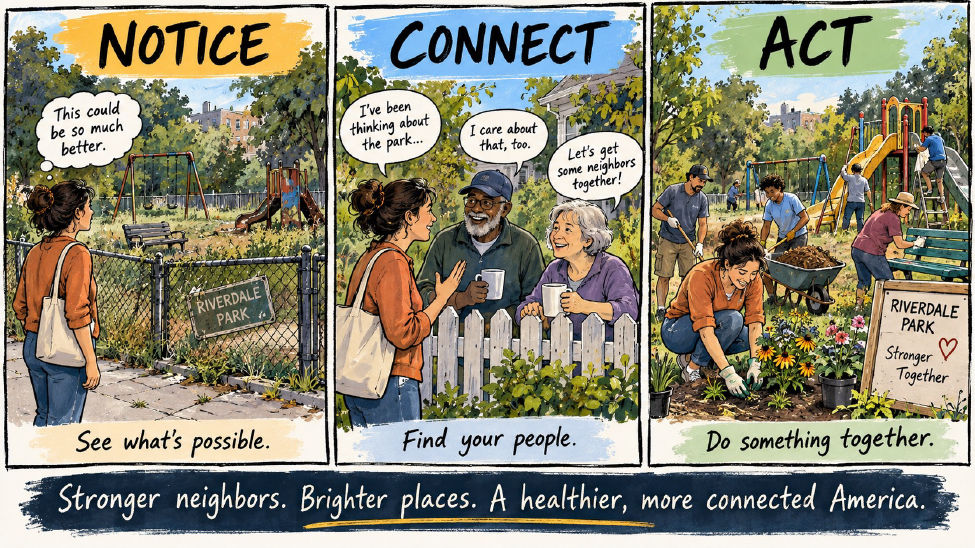
Borrowing a line from Bill Clinton, I said to the one hundred people assembled that there is nothing wrong with our country that cannot be fixed by what is right with our country. Because it was on Zoom, I made a background for myself picturing a framed poster. On the poster were three words which, to me, are magic: Notice. Connect. Act.
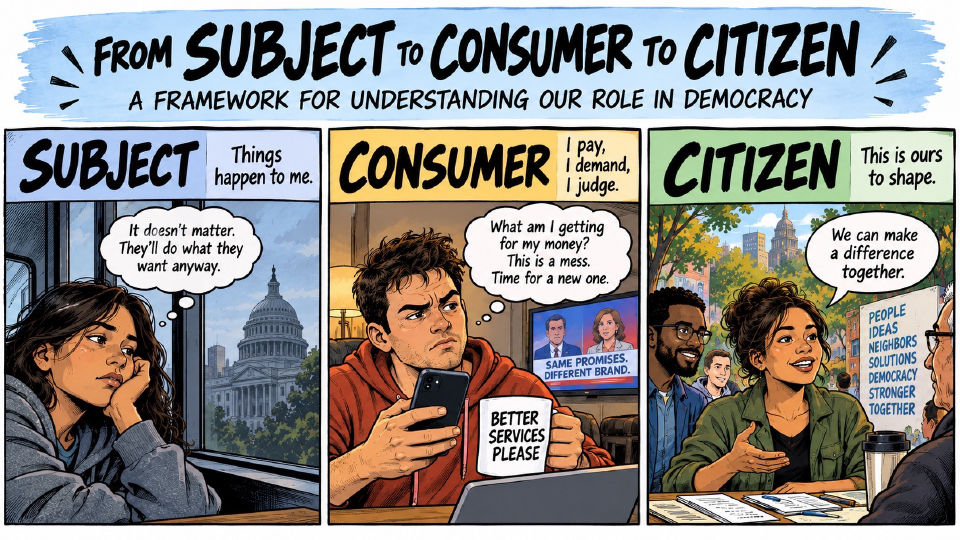
In the talk, as I do in my book, I distinguished what it means to be a citizen from what it means to play the role of a subject or a consumer. Also three words, but not the magic ones. I described citizenship as something one does. It’s far more than a legal status, I said.
I showed the picture below, three panels from a graphic novel I’m working on, based on an idea by Jon Alexander:I went further. I said when we’re in the citizen mode, we employ those magic words: We notice. We connect. We act.
Notice
In Citizen mode, we notice something we care about that could be improved. For one person, this might be noticing cars running stop signs in their neighborhood, for another it might be noticing that an empty lot is becoming an eyesore, for a hero of mine, sixteen-year-old Sarah Kokas, it means noticing that often kids in homeless shelters don’t have birthday cakes. (I’m going to tell you more about Sarah soon.)
Connect
When we notice something we care about that could be improved, we are almost certainly not the only ones. Often others care about what we care about—dangerous intersections, ugly lots full of trash, kids going without. In citizen mode, we find a way to connect with some of them. We say things like, “Does this bother you, too?” and “I have an idea about improving this. What do you think?”
Act
When we begin to take action with others to improve something we care about, we often flounder around at first. If we want to address a traffic problem, we have no idea who to call. And when we do, we get recorded messages. We often feel stymied. But if we persist, someone comes up with an idea that helps us move forward: Instead of calling, let’s go to City Hall with our map, our photos, and our daily counts of drivers running the stop sign. Instead of feeling bad when we walk past that unsightly lot, let’s gather some garden tools and some neighbors and clean it up. Instead of silently witnessing the disappointment of a child without a birthday cake, let’s bake one.
What can I do?
When I give talks about the themes in my book, I’m generally good at getting people feeling they want to do more to help our troubled country. This is the easy part.
I know I’m getting through when a hand raises and someone asks, “You’ve got my attention, but I don’t know what to do.” And if this does not happen, I ask this: “Who is sitting there listening to all of this and wondering, ‘I hear the call and feel motivated to help, but I don’t know where I’d start?” 90% of the hands go up.
My answer is always the same; not a litany of actions others are taking, but another question from me: “What is yours to do?”
At first, this is a bit puzzling for folks, so I explain. I say that each of us has distinct passions, skills, and interests. We notice things that many others don’t. We’re bothered at times by what we see. This is the arena in which such a question gets answered.
Then, I ask, “What do you notice that you care about, something that could be improved?”
I wait for an answer. One person said to me that he lives on a street where no one knows anyone even though there had been some break-ins. They could help one another, perhaps by starting a Town Watch. He knows someone who knows how it works. Bingo.
Light Many Fires
In my book, I urge readers not to try to fix America. Instead, fix a neighborhood, I say. Start small. I call this lighting a candle. This is what a dear friend did who was troubled about a local rail line that might shut down stranding people who depend on it. Her “candle” was putting educational leaflets on cars in the parking lots. It took her one hour.
If you have more energy and time and feel more confident, light a torch, i.e., take on a bigger project. That’s what my friend Barbara did when she and some others began an adults civics education program in her community. They've been meeting monthly for nearly two years. They started slow, but now sixty people show up every time.
As you get your sea legs, perhaps you light a bonfire as my friend Zak did. A Tai Chi teacher, he started three schools in three neighborhoods that brought people together.
No one is asking you to save America. You don’t have to become an activist or a militant. Just be you: Notice what could be improved. Connect with some others. Act to improve things.
But Wait…
How does baking cakes and cleaning up lots or doing Tai Chi with neighbors fix America? It doesn’t. But it restores local accountability, agency, and builds trust. These things are to democracy what food and oxygen are to the human body.
Imagine that 5% more Americans began to notice, connect, and act. What would change? That’s 13.5 million people. Imagine what would happen if 13.5 million people stopped feeling helpless and began organizing with others around practical problems. Imagine 13.5 million more people voting. This would change elections.
Notice. Connect. Act. The three magic words of citizenship.


Comments