
We the Exhausted Majority
Don't believe the headlines about polarization.
Here's an example. Is it true or false? “America is a nation split into two furious camps, locked in an endless culture war.”
It's actually false or mostly false. It's a picture that is badly distorted. The next time someone tries to intimate that we are a nation of slavering jackels at one another's throats, push back.
In my book, When We The People Lead, The Leaders Will Follow, I spell out what is far closer to the truth: There is polarization in our country, but it's between the extremes of our political "wings", those on thefar-right and those on the far-left. I'm not making this up. For just one data point--a very compelling one—check out moreincommon.com.
There are worrisome consequences of believing this distortion, namely, cynicism and passivity. When we believe that all Americans are at one another's throats, we eye others with suspicion, disengage, and lose our voice. Some become so discouraged they even stop voting.
Most Americans are not ideologues and do not hate one another. On a host of issues, Americans, even across so-called “red” states and “blue” states, agree on many issues. The actual distribution looks more like the curve on the right. Morris Fiorina and others at Stanford conclude that "There is little evidence that Americans’ ideological or policy
positions are more polarized today than they were two or three decades ago."
We may not be all that polarized, but we are tired. A growing body of research—most famously the Hidden Tribes studies by More in Common—shows that roughly two-thirds (67%) of Americans fall into what researchers call the Exhausted Majority. These citizens—most of us—are neither progressive activists nor conservative radicals.
Who Is the Exhausted Majority?
The Exhausted Majority cuts across age, race, religion, and geography. What unites the group is not ideology, but life experience. This majority consists of decent people who don’t think of themselves in political terms at all, people who just want to live their lives, make a buck, and raise their families. They believe that politics has become needlessly cruel, loud, and unproductive and they are sick of it.
Importantly, those in the Exhausted Majority are not apathetic. They—we—are disillusioned and many are disengaged.
On a great many issues, they—we—agree: gun control, a woman’s right to choose, race relations, money in politics, among many others. But they feel invisible in our politics—and are. They value fairness, freedom, and equal dignity. They tend to support democratic norms and reject political violence. But most politicians neither see them nor hear them.
And so they retreat.
The Loud Minority Problem
One of the most sobering findings of the Hidden Tribes research is that while the Exhausted Majority makes up about two-thirds of the population, political life is increasingly shaped by a much smaller group of highly engaged activists at the left and right extremes.
These “loud minorities” dominate social media, primary elections, fundraising, and cable news. They speak in absolutes. They reward outrage. They punish nuance.
The result is a dangerous feedback loop. As I note in my book, when politics becomes more hostile and performative, the Exhausted Majority withdraws. That withdrawal, in turn, gives the extremes even more influence. The system becomes less trusted and less representative. Polarization, the research shows, is not driven primarily by growing ideological disagreement among most Americans. It is driven by what might be called “participation asymmetry.”
Misperceptions and the Perception Gap
Another striking finding of the More in Common research is how wrong Americans are about one another.
Most people dramatically overestimate how extreme their political opponents are. They believe those on the “other side” are more hateful, more authoritarian, and more committed to violence than they actually are. These misperceptions are fueled by social media, partisan media ecosystems, and the tendency of extreme voices to travel furthest. (In five minutes, you can get feedback on how accurate your perceptions are of those you consider politically different from yourself here.)
Why This Matters for Democracy
Democracy depends on participation—not just voting, but presence, voice, and trust. When a supermajority of citizens opts out, power doesn’t disappear. It concentrates.
The Exhausted Majority still believes in democratic ideals, but belief without engagement is not enough. Over time, disengagement erodes accountability, weakens institutions, and creates openings for authoritarian movements that thrive on division and cynicism.
The research suggests something crucial: America’s core problem is not too much disagreement. It is too little shared ownership of the democratic project.
A Different Way Forward
The hopeful news is that the Exhausted Majority is not lost.
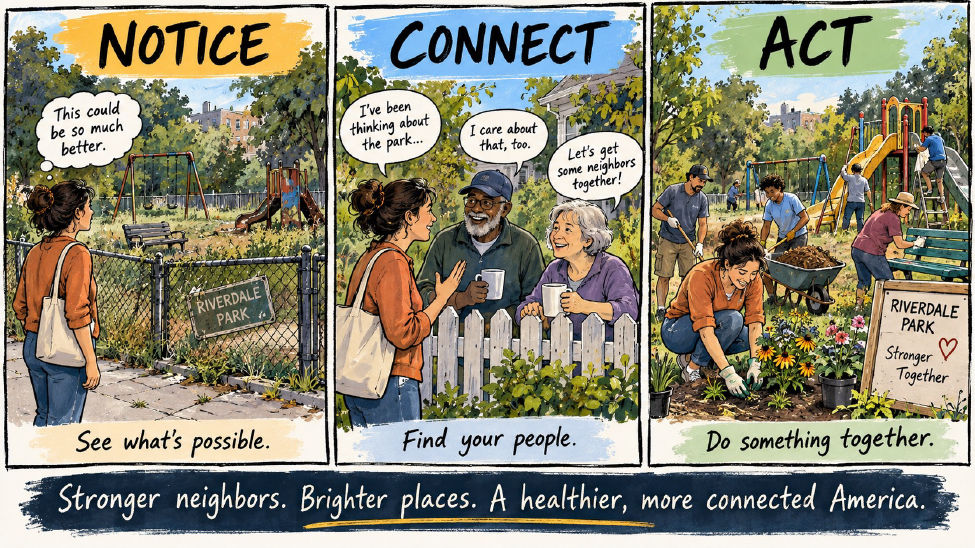
When people feel heard, respected, and invited into constructive roles—as neighbors, problem-solvers, and citizens rather than combatants—their willingness to engage increases. Local action matters. Civic rituals matter. Spaces that reward listening rather than performance matter.
Democratic renewal does not begin by converting extremists. It begins by reactivating the decent, capable, exhausted people in the middle—people who still believe, quietly, that this country is worth the effort.
The future of American democracy will not be decided by the loudest voices. It will be decided by whether the Exhausted Majority chooses to step back into the room.
And whether we build a politics that welcomes them when they do.

Comments