
Why I Wish We’d Stop Saying America Is Deeply Polarized

When we say “We’re all polarized,” we empower extreme voices, contribute to sidelining the Exhausted Majority, and encourage our own passivity.
A RECENT COLUMN IN THE NYT notes the growing pushback of Americans against data centers, observing that “more than half of all Americans support a national ban.”
I like hearing this, but then, it goes onto to say something that almost breaks my heart: “In our virulently partisan country, this constitutes a rare show of consensus.” In fact, Americans are in consensus on a lot of things. This statement is a gross distortion of the truth.
The claim that we’re all polarized is repeated in headlines, casual conversations, and even well-intentioned civic discussions. This past weekend I attended a TED Conference on democracy here in Philadelphia. I heard three speakers say this. This leads to an unfortunate and inaccurate conclusion: There is no way out and there is nothing I can do.
While claiming Americans are polarized contains a grain of truth, it has hardened into something worrisome: It has become the story of our time. And that story encourages despair, passivity, cynicism, and withdrawal.
Polarization At The Margins Is Real—But It’s Not Where Most People Live
It’s true that political rhetoric has become harsher and that party identities are stronger than they once were.
But research consistently shows that the vast majority of Americans—the group More in Common calls the Exhausted Majority—do not occupy the ideological extremes. On a long list of issues—from money in politics, a woman’s right to choose, sensible gun laws, and many others—Americans see eye-to-eye far more than headlines suggest. According to research that comes out of Stanford, this holds even across so-called “blue” states and “red” states.
Here is what is true: What most distorts American politics is not widespread ideological warfare. It is uneven participation.
Today, the loudest and most extreme voices dominate public debate, while the broad middle remains largely unheard and invisible. As people amplify the narrative of polarization, many members of the Exhausted Majority disengage. The result is a politics that makes Americans appear far more polarized than we are.
The parties that are polarized—the “wings” pictured on the left and right, below—show up relentlessly. They vote in disproportional numbers. They organize. They fundraise. They speak in absolutes. They shout. They tell us we hate one another.

The Polarization Story Serves Only Some
Who benefits from this narrative? When we accept—and especially when we repeat—the claim that America is hopelessly polarized, we unintentionally strengthen forces that most people distrust: those who profit from division.
Who are they?
Journalist Amanda Ripley coined the term “conflict entrepreneurs”—politicians, social media moguls, podcasters, influencers, and many news organizations—to refer to these parties. They gain ground when they tell us that compromise is impossible, common ground is a fantasy, and the people on the other side are beyond reach. They jump for joy when ordinary Americans repeat this.
When ordinary citizens accept that view, many disengage. While conducting research for my book, I met people who no longer vote because they are exhausted by the rancor and hostility they see in politics.
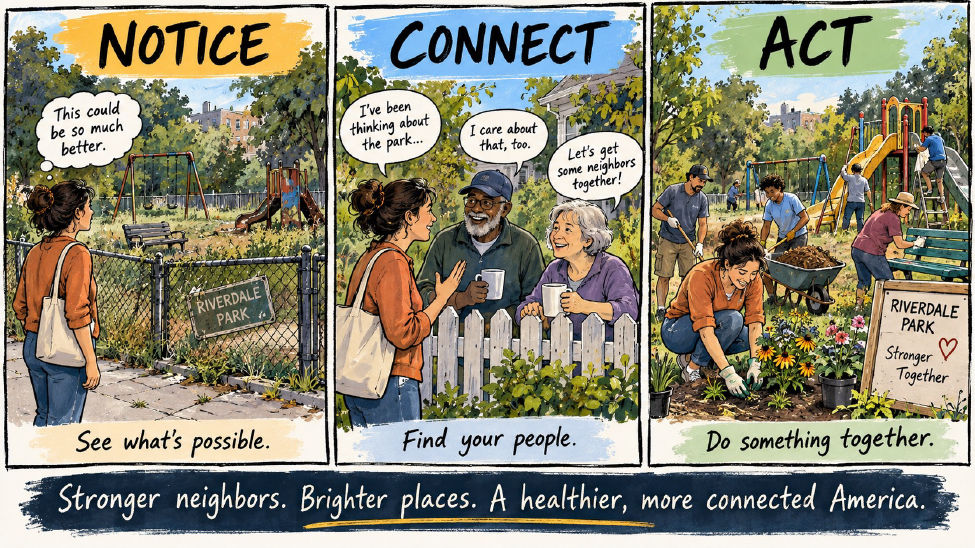
The costs extend beyond elections. When we come to see division as our defining characteristic, we stop looking for common interests and shared goals. We invest less in the local institutions where practical problem-solving still occurs. And we avoid conversations with neighbors who do not fit our assumptions.
What To Say When You Hear “We’re so polarized.”
The next time you hear someone say that Americans are all polarized, consider saying something like this:
· “I agree that there is a divide: It’s between people who profit from outrage and everyone else.”
· “I don’t deny that politicians and people in the media are polarized. I question whether most Americans are. Most people I know are decent, eager to help others, and kind. They don’t hate people.”
· “If we were truly split into two irreconcilable camps, there wouldn’t be so many Americans who tell pollsters they dislike both parties.”
The next time you hear “We’re all so polarized,” what do you think you will say?

Comments