
Why the Young Aren’t Showing Up
Updated: May 13
OLDER AMERICANS often look at younger voters and see apathy. They see low turnout at No Kings rallies and note weak voting participation, then conclude that young people are apathetic.
I believe this conclusion misses what is happening.
The issue is not that younger Americans don’t care. It’s that many young people don’t think their participation will make a meaningful difference in improving things. That distinction matters enormously.
Young people, compared to older Americans, are more disengaged from civic life. For instance, Americans under 40 vote at significantly lower rates than older citizens (45% vs. 70%), are less likely to belong to civic or neighborhood organizations, and often report feeling disconnected from both political institutions and community life. But I think we’re wrong to see disengagement as a motivation problem. To assume that younger people need more passion, more outrage, more awareness, and more political savvy, is wrong.
Most younger Americans are highly aware of what is going on in our country. And though education rates are uneven by class, geography, and race, this is the most highly educated generation we’ve ever seen. And they are not naïve. They came of age amid climate anxiety, political dysfunction, economic precarity, endless online conflict, and declining trust in nearly every institution in American life. They are well aware that our system is broken in many ways.
In short, young people are not asleep—the better term is to say they are emotionally exhausted.
I have found it useful to think about civic engagement by considering how two variables interact: concern and efficacy. Concern refers to how much someone cares about what is happening in the country. Efficacy refers to whether a person believes their actions can make a difference.

© 2026, Richard McKnight
When both concern and efficacy are high, people engage: They vote, organize, volunteer, and participate in civic life.
But when concern is high and efficacy is low, something different happens. People withdraw. Not because they are indifferent, necessarily, but because they are unconvinced that their actions will make any difference.
I have met many younger Americans who fit this description perfectly. (And some who don’t.)
In short, young people are not asleep—they are emotionally exhausted.
One young man I interviewed for my book said he follows the news closely, worries deeply about the direction of the country, and admires people who attend political rallies. Yet he has attended none himself. “What difference would it make?” he asked.
A young woman I spoke to criticized extreme politicians, decried polarization, and worried about democratic decline but dismissed marches entirely. She said she believes local action might matter more than symbolic protest. Yet when I asked whether she belonged to any neighborhood or civic groups, she admitted she did not.
These are not apathetic people. They are people struggling to believe that participation leads anywhere.
Research strongly supports this interpretation. The Hidden Tribes study by More in Common found large numbers of younger Americans concentrated in groups characterized by alienation, pessimism, and low institutional trust. Many reported feeling politically homeless, socially disconnected, and doubtful that collective action accomplishes much.
At the same time, younger Americans have spent much of their lives watching institutions fail publicly and repeatedly, they’ve witnessed financial collapse, endless wars, political paralysis, carried high levels of student debt, been put off by high housing costs, and daily experience an internet culture that rewards irony more than commitment.
Cynicism, under these conditions, begins to look like realism, detachment with wisdom.
On the plus side, there are important signs that this generation is not unreachable. In fact, the young today are probably unusually hungry for meaningful forms of participation. As one data point, the Mamdani campaign in New York City saw 100,000 young people get involved. Asked why, one volunteer told a reporter that her involvement felt therapeutic to her.
Many traditional forms of civic engagement—think No Kings rallies—were built for an earlier era in which Americans still possessed relatively high institutional trust. Today’s younger Americans famously lack such trust.
When younger people do become engaged, they often do so with remarkable intensity and commitment, suggesting not a lack of civic desire but a search for forms of engagement that feel authentic, relational, and capable of producing visible change. The success of campaigns and movements that have mobilized large numbers of younger volunteers around tangible, lived concerns hints at a generation still eager to contribute—if they can believe their contribution matters.
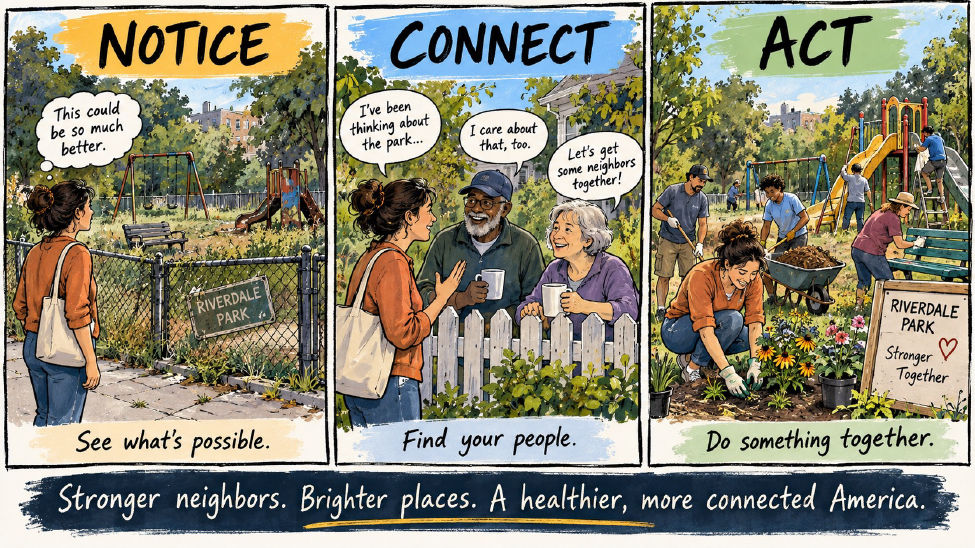
When leaders get young people to engage today, it is often through efforts that feel tangible, local, relational, and immediate. They join mutual aid efforts after disasters. They volunteer for campaigns organized around concrete material concerns like housing or healthcare. They build local climate organizations. They participate in projects where they can see outcomes and experience belonging.
Notice the pattern.
These efforts do not merely ask people to express outrage or wave clever signs—or give up a Saturday. They allow people to experience efficacy. This may be what we in older generations are not understanding.
Many traditional forms of civic engagement—think No Kings rallies—were built for an earlier era in which Americans still possessed relatively high institutional trust. Today’s younger Americans famously lack such trust. Asking them simply to “show up” for symbolic politics clearly is not hitting home.
The challenge before us—before all Americans—is not merely persuading younger Americans to care more. Most already do. The challenge is designing forms of civic engagement that restore the belief that participation matters.
That means creating opportunities where people can see visible outcomes, work alongside others, build relationships, and contribute in ways connected to everyday life. It means moving beyond politics as performance and toward citizenship as lived experience.
In my book, When We The People Lead, The Leaders Will Follow, I tell the stories of many young people and how they see our country. The book has an entire chapter (“The Inheritors”) on the role young Americans currently play in our democracy and what they stand to lose if their patterns of engagement do not change.

Comments