
Do We Need a Statue of Responsibility?
NEAR THE END OF HIS MAGNIFICENT BOOK, Man’s Search for Meaning, written in 1945, psychiatrist and Holocaust survivor Viktor Frankl offers an observation that feels surprisingly relevant to America today.
“Freedom,” he writes, “is in danger of degenerating into mere arbitrariness unless it is lived in terms of responsibleness.”
What he meant was freedom without responsibility is no more than selfishness.
In this book, Frankl makes a remarkable suggestion. The Statue of Liberty on the East coast, he says, should be supplemented by a Statue of Responsibility on the West Coast.
Frankl wasn’t criticizing liberty. Having survived Nazi concentration camps, he understood better than most people what it meant to lose freedom. Rather, he was reminding us that freedom without liberty quickly sours. Liberty tells us what we are free from. Responsibility tells us what we are free for.
Without that second half, freedom eventually begins to consume itself.  Author Stephen Covey (Seven Habits of Highly Effective People), who knew Frankl personally, was so taken with the idea that he reportedly promised Frankl he would try to see the monument built. Years later he commissioned a sculptor to design it. For various reasons, the monument has never been built.
Perhaps that is fitting. Maybe the real monument was never meant to be made of stone but rather of commitment and dedication.
Our political language today is saturated with the language of freedom. We speak of the freedom to say what we wish, buy what we want, carry what we choose, educate our children as we see fit, spend our money as we please, and live according to our own values. Freedom has become the highest political value, the first answer to nearly every public question.
But responsibility rarely appears in our conversation.
We defend our rights with remarkable energy while in today’s America, we speak much less often about our obligations—to one another, to our communities, to future generations, and to the institutions that make freedom possible in the first place.
The result is a culture that increasingly confuses liberty with the absence of limits. We adhere to individualistic codes of conduct today, as if we share little with others.
Yet every worthwhile freedom depends upon boundaries. Freedom of speech depends upon enough honesty and restraint that words retain their meaning.
Economic freedom depends upon enough fairness that markets continue to command public trust.
As I wrote a few weeks ago, the freedom to drive depends upon stopping at red lights.
And then there is democracy itself. It depends upon citizens who willingly accept obligations that no law can compel: telling the truth, listening to neighbors, voting, serving on juries, volunteering, compromising, keeping promises, and occasionally sacrificing personal advantage for the common good.
These are not restrictions on freedom. They are the conditions that make freedom sustainable.
We often imagine responsibility as something imposed upon us. Frankl saw it differently. Responsibility is what gives freedom its purpose. Without it, liberty slowly becomes self-centered. We begin to ask only, “What can I do?” instead of “What ought I do?” Rights become detached from duties. Personal preference replaces shared purpose. Eventually, we find ourselves with abundant individual liberty but a diminished common life.
Perhaps this helps explain why so many Americans today feel simultaneously free and lonely, empowered and disconnected.
Today, we have become exceptionally good at protecting individual choice while forgetting that the deepest satisfactions often arise from commitments we willingly embrace—to families, neighborhoods, congregations, friendships, and communities.
The Statue of Liberty still holds a lamp to the promise of freedom. Perhaps the Statue of Responsibility, whether it is ever built or not, reminds us how that promise is fulfilled—when each of us take some responsibility for all of us.
If liberty is America’s greatest gift to the world, responsibility may yet prove to be its greatest unfinished work.
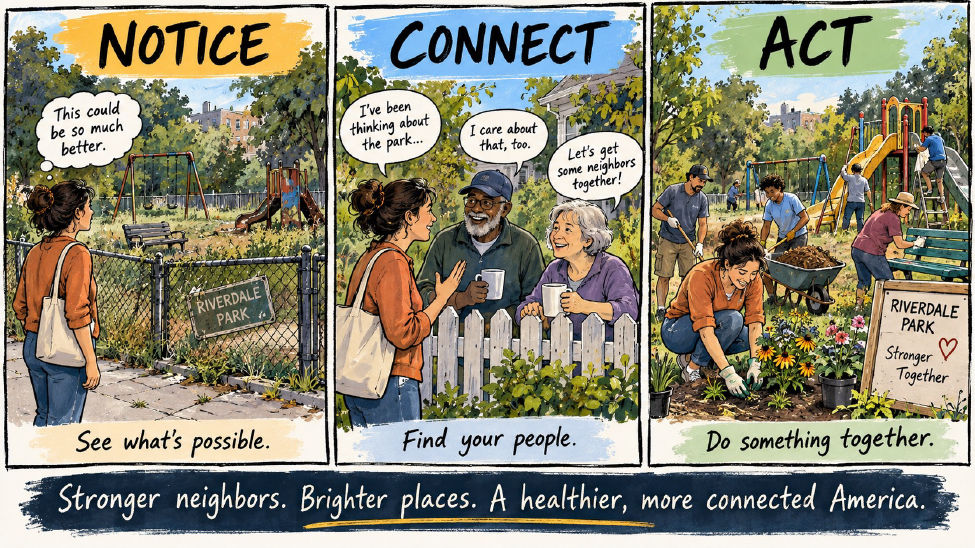
What would change if each of us became the Statue of Responsibility in our own community? |

Comments