
Move Toward, Not Against
A Better Way to Engage People Whose Politics We Don’t Share
At an event I was facilitating recently about active citizenship, a couple of people said they hoped they would come away from the session better equipped to talk to people whose political views are different from theirs.
I got the feeling they were after ideas about how to change others’ minds.
I understand the impulse, especially if you live with people whose views are extreme or have them as neighbors. But the more I thought about it, the more I realized some of us are wanting to get good at something—changing others’ minds—that almost none of us can accomplish.
I think we are all better off setting this objective aside in favor of getting involved in building community with those whose views we don’t like. Working together often changes minds—but only as a byproduct, never when it’s the objective.
Why Trying to Change Others Doesn’t Work
First off, no one likes being treated as a problem to be solved. If changing how others think is your objective, you’re apt to produce defensiveness and curtail curiosity.
And when we set out to change another’s mind, we forget that it’s not really opinions that are at the heart of the matter but identity. And identity does not readily yield to logic.
Further, when we try to get others to change, we usually produce more disagreement than anything else.
Finally, persuasion puts politics at the center of the relationship. It’s objectifying. We place ourselves in the relationship as a spectator and an evaluator.

Move Towards Others
A long time ago, I read the work of a psychoanalyst who maintained that when things go wrong in a relationship, we always have three choices: move away from the other, move against them, or move toward them. Objectifying and trying to persuade is a form of moving against. We get farther when we move toward.
A story from workshop was vivid. A participant described asking a local beer distributor if he would put up a sign advertising an environmental gathering.
“I don’t believe in that shit,” the distributor replied.
“Okay,” the participant said. “But would you put up the sign anyway?”
“Sure,” the distributor answered. “No problem.”
Neither person tried to change the other’s beliefs. The organizer didn’t argue about climate change, and the distributor didn’t pretend to agree. Instead, they found a way to cooperate in support of their community despite their disagreement. That’s the muscle democracy requires—not ideological agreement but the willingness to help one another build a community.
Imagine neighbors with opposite yard signs who together…
organize a food drive
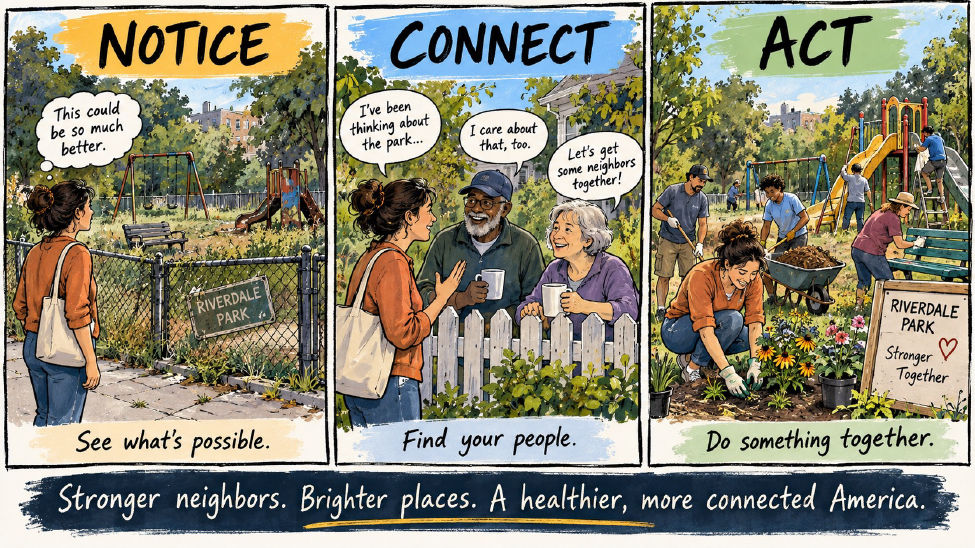
restore a playground
mentor local students
improve a park
create neighborhood emergency plans
volunteer at a library
None of these activities requires agreement about politics, yet they create something democracy desperately needs: trust.
If your goal is to solve a shared problem together, both of you may change, not because anyone “won,” but because the process of co-creation makes us partners, not combatants. Shared experience alters both of us.
Working alongside someone cultivates qualities in both parties that arguments never do: patience and appreciation. We may never agree on the merits of universal healthcare or global warming, but we can learn to enjoy one another’s company and respect one another’s competence and goodwill. We’ll probably enjoy a few laughs together, too.
It’s difficult to demonize someone who’s helping paint the community center beside you and with whom, afterwards, you have a beer or a coffee.
Perhaps our history can teach us something. American democracy has always depended on what Alexis de Tocqueville, who came here from France to study our democracy, noticed almost two centuries ago: Americans learned to be self-governing by doing things together.
People didn’t become neighbors because they agreed, they agreed on enough because they were committed to being good neighbors. Democracy has never depended on winning arguments. It depends on citizens who committed to building a common life despite disagreements.
What Can We Accomplish Together?
When people tell me they want to learn how to talk to those on the other side, I get it. We all hope for the conversation that melts suspicion and opens hearts.
But that’s asking too much of conversation, especially if the relationship lacks trust to begin with.
Instead of trying to change another’s mind, what if we tried changing our neighborhoods by working side by side? What if we planted gardens together, mentored children, restored parks, welcomed newcomers, supported local schools, or cleaned up a stream with people whose voting records differ from our own?
Something remarkable happens when we develop the habit of working together. We stop seeing one another primarily as Republicans or Democrats, progressives or conservatives. We begin seeing parents, veterans, retirees, teachers, mechanics, nurses, and neighbors. We discover qualities no political argument can reveal.
Perhaps becoming a citizen begins the moment we stop asking, “How do I convince them?” and start asking, “What can we accomplish together?”
Related:

Comments