
Do We Need a Cultural Climate Change?
Global warming isn’t the only type of climate change we’re facing.
And it might not be the worst.
WHEN WE AMERICANS TALK ABOUT the challenges facing our country, we usually point to politics or economics. We argue about elections, public policy, taxes, inflation, inequality, or government dysfunction.
These issues matter. But what if they are not the core of our troubles?
Rabbi Jonathan Sacks, who served as the United Kingdom’s chief rabbi from 1991 to 2013, believed they are not. In his superb book, Morality: Restoring the Common Good in Divided Times, Sacks points instead to what he calls the “cultural climate change” that has been underway for over 50 years in western democracies.

By cultural climate change, he means the erosion of the shared moral ecology that sustains a free society: our sense of mutual obligation, felt responsibility for the common good, and the willingness to cooperate with people beyond our immediate circles. In short, he says, our commitment to one another has lessened over the past fifty years. This, of course, has dire consequences for democracy.
Rabbi Sacks argues that every society rests on three systems:
The economic system produces wealth.
The political system produces power.
The moral system produces trust.
The first two are arenas of competition. The last is the arena of cooperation. The moral system is the least visible of the three, but for a self-governing people, Sacks contends, it is the most important. Without it, the other two systems do not work in ways that sustain freedom.
Sacks writes, “Morality achieves something almost miraculous…It creates trust. It means that to the extent that we belong to the same moral community, we can work together without constantly being on guard against violence, betrayal, exploitation, or deception.”
Without trust, economies become less productive because every transaction requires greater oversight, regulation, suspicion, and more litigation. Without trust, politics becomes a never-ending struggle for advantage in which opponents are viewed as enemies rather than fellow citizens. Without trust, communities weaken, relationships fray, and people become increasingly isolated from one another.
But Sacks point out that morality extracts a cost.
To become part of a society, we must accept limits on ourselves. We must learn to restrain impulses, keep promises, honor obligations, and consider the needs of others. We must be willing, at times, to sacrifice what is good for us individually for the sake of what is good for the group.
The cultural climate change Sacks is describing has come about as Western societies have undergone a profound cultural transformation over the last half-century. The organizing principle of life has gradually shifted from “WE” to “I.”
This does not mean people have become immoral. Sacks explicitly rejects that conclusion. Americans still volunteer, donate to charity, care for family members, and show compassion toward strangers. We remain moral beings.
What has changed is what we believe is in our best interest. We answer that question from an “I” perspective more than from a perspective.
Older generations that came of age in the 1950s and 1960s, spoke naturally about duty, responsibility, obligation, sacrifice, and the common good. Increasingly, those concepts have been overshadowed by a different set of priorities: autonomy, authenticity, self-expression, self-esteem, self-actualization, and individual choice. The older vocabulary has not disappeared entirely. Rather, the newer language has become dominant and pushed the older language to the margins.
The result is a paradox. In America, we enjoy greater freedom than perhaps any generation in history. We can choose where to live, whom to marry, what career to pursue, what beliefs to hold, and how to define ourselves. Yet, at the same time, Americans report feeling more lonely, anxious, disconnected, and uncertain than those who came before them. Sacks says, “certain things that our ancestors found so simple, we find difficult to the point of impossibility.” Among them is sustaining trust within a community.
A society cannot thrive on individual freedom alone. Human beings need communities, institutions, traditions, and shared purposes. We need places where people know our names, count on us, and expect something from us. We need opportunities to contribute to something larger than ourselves.
Sacks’ cultural climate change insight may help explain why so many seemingly unrelated problems have emerged together:
Political polarization
Declining trust in institutions
Rising loneliness
Civic disengagement
High rates of suicide
Widespread anxiety
These are not disparate problems, Sacks argues. They are different expressions of the same underlying change.
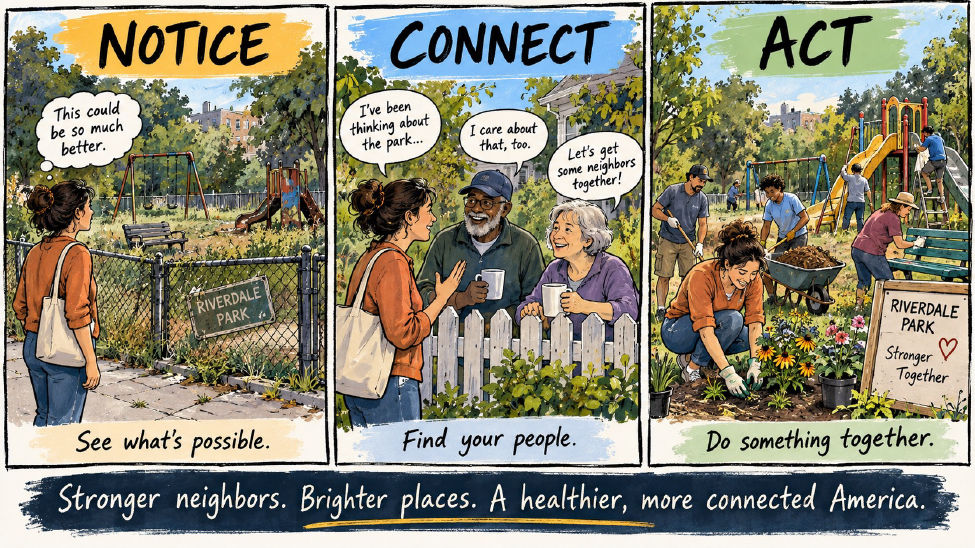
If Sacks is right, then the solutions to our problems will require more than policy reforms or better political messages. They will require rebuilding the habits, relationships, and institutions that teach people how to live as part of a “WE.”
The challenge before us is not to abandon individual freedom. This is one of humanity’s greatest achievements. The challenge is to pair freedom with responsibility, rights with obligations, and self-expression with commitment to others.
If Sacks is right that we have moved from “WE” to “I,” then cultural climate change is not beyond our power to reverse. Every time we step beyond our own self-interest to serve a neighbor, strengthen a community, or contribute to our country, we begin to change the climate.
What might become possible if enough of us chose, once again, to become a “WE” climate?
Note: I mention the Sacks book in my review of Sen. Chris Murphy’s bestseller, Crisis of the Common Good. You can read that review here.
Related:

Comments